Skip to Content

Certificates and Licences

The flight school of the Côte d'Or aeroclub, approved by the DGAC, now a training organisation registered FR.DTO.0083, offers theoretical and practical training for obtaining Pilot Licences and certificates (LAPL, PPL) and ultralight aircraft  / microlight aircraft (Ultra-Léger Motorisé ULM), as well as additional qualifications in Aerobatics (FCL800) and Night Flying (VFRN).

Avion Robin DR400

LAPL / PPL Aircraft

Becoming a private pilot is an exciting adventure that begins with a fundamental choice: to orient towards the LAPL (Light Aircraft Pilot Licence) or towards the PPL (Private Pilot Licence).
Both licences allow you to discover the joy of flying, but they are clearly distinguished by their training, requirements, and the privileges they offer.

The LAPL is designed for those who wish to fly simply, in a primarily recreational or leisure context.
The practical training is shorter than the PPL with a minimum of 30 hours, including 15 hours of dual instruction and 6 hours of supervised solo.
The training and theoretical exam are identical (Weather, navigation, regulations, performance, etc.).
The licence is obtained at the end of the training, upon passing the theoretical exam and successfully completing a flight test with an examiner pilot.
The associated privileges are visual flight only with a maximum of 3 passengers in an aircraft of 2000kg maximum within the European Union.

The PPL is the international reference licence for private pilots.
It is aimed at those who want to travel further, progress, or even consider a professional path.
Practical training is longer with a minimum of 45 hours, including 25 hours in dual control and 10 hours in supervised solo.
The training and theoretical exam are identical (Weather, navigation, regulations, performance, etc.).
The licence is obtained at the end of the training, upon passing the theoretical exam and successfully completing a flight test with an examiner pilot.
The associated privileges are visual flight with as many passengers as the aircraft allows worldwide according to international agreements.
Night flying, instrument flying, and multi-engine flying are possible subject to additional qualifications.

• The LAPL is perfect for discovering flying, flying locally, and enjoying the pleasure of aviation without too many constraints.

• The PPL opens the door to a much wider universe: travel, advanced qualifications, and even a future career as a professional pilot and airline pilot.

ULM Humbert Tetras

Class 3 ULM

ULM represents one of the most accessible and exciting ways to discover flying today. Flexible, modern, and focused on the pleasure of flight, ULM training allows everyone to become a pilot while enjoying a lighter regulatory framework and great freedom.

Among the different categories of ULM, the class 3 multi-axis occupies a central place and attracts many pilots for its versatility and performance.

ULM pilot training is based on two pillars: Theory (Weather, navigation, regulations, performance, etc.) and practical training in dual control with an instructor followed by supervised solo.
The total duration depends on the student's pace, but is generally shorter and more flexible than in certified aviation.

Class 3 includes the so-called multi-axis microlights., which are aircraft similar to light planes, with a rigid structure, fixed wings, and conventional controls (stick, rudder pedals), high performance (150 to 200 km/h), and modern equipment (glass cockpit, GPS, transponders).


Once licensed, the microlight pilot enjoys the privilege of flying visually in France and certain European countries (depending on agreements) with a passenger (after obtaining the passenger-carrying qualification) by accessing a wide network of microlight bases and airfields.

And among all categories, the class 3stands out for its comfort, stability, and travel capabilities, making it the preferred choice for many pilots wishing to combine freedom and performance.

Additional qualifications
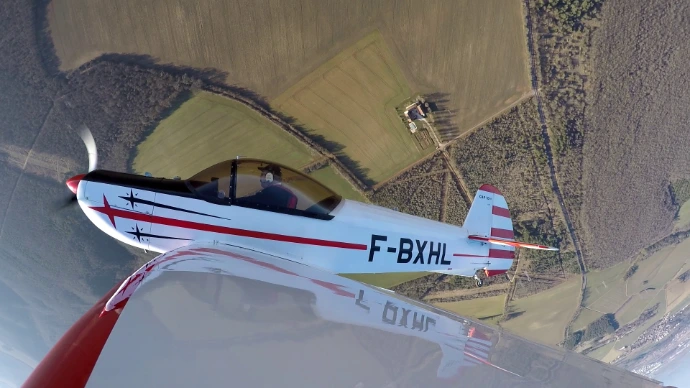
Voltige

AEROBATICS

The excellence of piloting in the service of mastery and precision, the Aerobatics qualification (FCL.800) is one of the most beautiful developments possible in the career of a pilot holding an LAPL(A) or PPL(A) licence. It opens the door to a spectacular, technical, and profoundly formative discipline, where the pilot learns to master their aircraft in all attitudes and push their limits safely.

Aerobatics is not just an aerial art: it is a school of rigor and mastery.
It allows the pilot to understand and exploit the performance of their aircraft, to develop exceptional flying precision, to manage unusual attitudes and degraded situations, to strengthen their confidence and anticipation skills, and to elevate their overall safety level in flight.
It is a training that sustainably transforms the way of flying.

The aerobatics training consists of two complementary parts, designed to ensure safe and effective progression.

The theoretical training covers the essential knowledge for practicing aerobatics: Aerodynamics specific to high angles of attack, Load factors and structural limits, Pilot physiology (G+, G–, effort management), Emergency procedures and recovery from abnormal attitudes, Regulations related to aerobatics and dedicated areas.
This theoretical foundation allows for an understanding of the physical phenomena and constraints specific to the discipline.

The practical training conducted on a certified aerobatic aircraft, includes: Familiarization with the aircraft in unusual attitudes, Progressive learning of basic figures (loop, roll, inversion, spin, turns, recoveries), Energy and trajectory management, Precision, symmetry, and coordination work, Sequences of figures and construction of sequences, Spin recovery techniques.
Progression is personalized, with a constant emphasis on safety and mastery.

The Aerobatics Qualification (FCL.800) is a demanding, exciting, and extremely formative training.
It allows the pilot to gain exceptional control of their aircraft, improve their safety in flight, and discover an aeronautical discipline that is both technical, artistic, and deeply rewarding.

Vol de Nuit

NIGHT FLIGHT

The Night VFR qualification is a valuable extension for any pilot holding an LAPL(A) or PPL(A) licence.
It allows for the discovery of a different aeronautical universe, where the finesse of piloting, the rigour of navigation, and the management of perceptions take on particular importance.
Flying at night means accessing a new freedom, but also a higher level of skill.

Beyond the pleasure, this qualification enhances the overall safety of the pilot through better mastery of basic instrument flying and specific procedures.
It also offers the opportunity to expand navigation slots.

The theoretical training covers the essential knowledge for night flying:
Pilot physiology (night vision, sensory illusions),
Specific regulations for night flying,
Aircraft performance and limitations,
Navigation and flight preparation,
Use of radio aids and instruments,
Management of particular situations.
This part allows the pilot to understand the specifics of flying in a reduced visual environment.

The practical training takes place on an aircraft certified for night flying and includes:
Familiarization flights with dual controls,
Maneuverability and axis holding exercises,
Night take-offs and landings,
Night navigation in the countryside,
Working with external references and instruments,
Management of failures and emergency procedures.
The training also includes a minimum of supervised solo hours, ensuring the pilot's autonomy.

The Night VFR qualification is a rewarding and formative step in a pilot's progression, significantly improving situational awareness, instrument management, and the pilot's decision-making ability.
It opens the door to a new dimension of flying, more technical, more demanding, but also incredibly rewarding.

It is a training that enhances safety, broadens navigation possibilities, and deeply enriches the aeronautical experience.
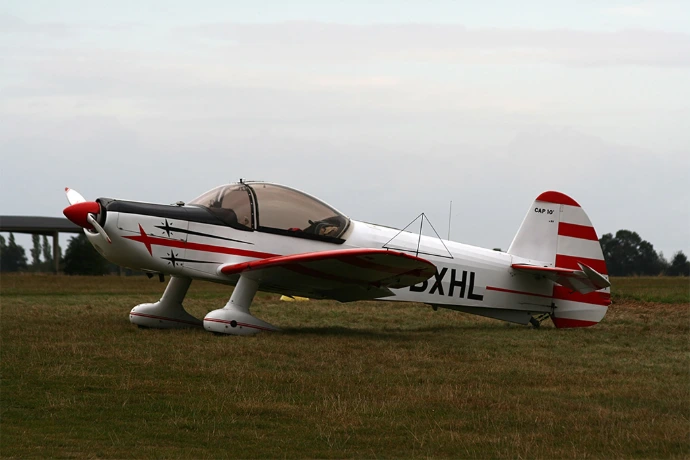
Train classique

VARIANTS

The LAPL(A) or PPL(A) regulations offer the possibility to acquire additional variants allowing the piloting of aircraft with specific characteristics.
These variants enrich the pilot's experience, expand their operational scope, and enhance their technical mastery.
Among the most sought after are the TW (Tail Wheel) variant and the SLPC (Single Lever Power Control) variant.

Each variant corresponds to a specific skill, validated by an authorised instructor and recorded in the pilot's logbook.

The TW "TailWheel" variant allows for the piloting of aircraft with a tailwheel landing gear, identifiable by their rear wheel.
These aircraft, often older, lighter, and more agile, require fine control of piloting on the ground as well as during take-off and landing.
This know-how provides access to a wide range of historical, leisure, and most aerobatic aircraft.
The TW variant is often regarded as a true enhancement, highly valued by pilots wishing to progress technically.

The SLPC "Single Lever Power Control" variant allows pilots to operate aircraft where the single lever engine management simultaneously controls power and the propeller.

This device, increasingly common on modern aircraft, simplifies engine management while requiring a fine understanding of its operation.
The SLPC variant is part of a modernization approach to flying, in line with the evolution of current aircraft.

These training courses represent a genuine investment in the pilot's progression, both in terms of safety and the pleasure of flying.